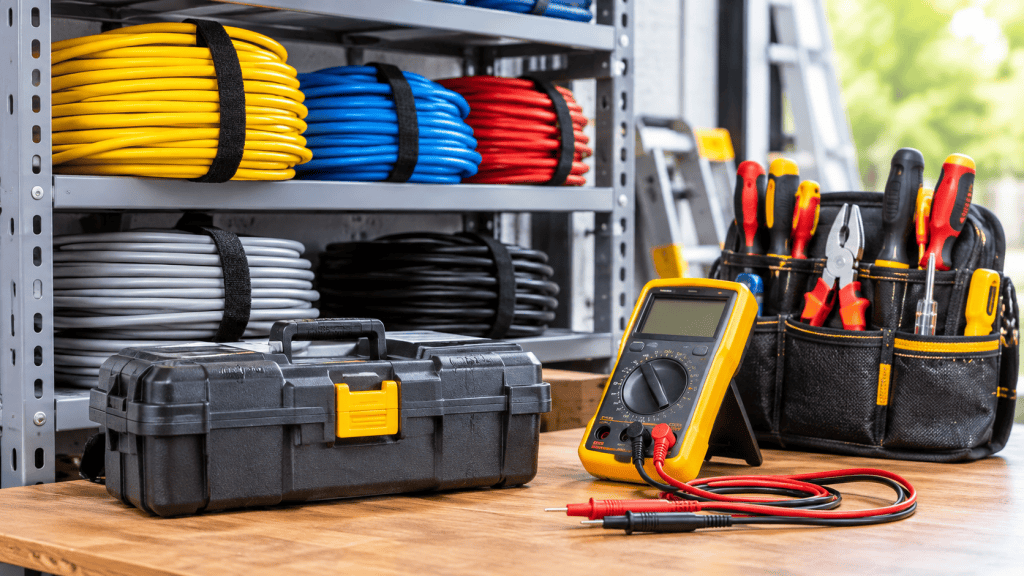
If you are wondering how to store electrical cable, the short answer is this: keep it clean, dry, loosely coiled or on its reel, off the floor, and locked somewhere other than your van overnight. Test equipment needs the same care, plus padded cases, stable conditions, and a clear record of where each instrument lives.
For electricians, storage is not a housekeeping chore. Cable drums, multifunction testers, insulation resistance meters and installation kits represent a serious investment, and work stops when one goes missing or gives unreliable readings. This guide explains why storage matters, sets out a practical system for cable and test gear, and covers the security measures that keep your kit exactly where you left it.
Why Proper Storage Matters for Electrical Tools and Equipment
Poor storage rarely shows up as a single big problem. It shows up as damaged insulation, failed tests, lost hours, and stolen kit, each one eating into your margin.
- Insulation damage: Sheathing that is crushed, kinked, or exposed to sunlight and heat can crack or deform. Damaged cable may fail inspection or become a hazard once it is installed.
- Instrument accuracy: Testers are built for site work, but drops, damp, and temperature swings can affect readings and leads. An unreliable tester puts every certificate you sign in doubt.
- Van theft: Tools left in vehicles overnight are a familiar target for thieves. A single break-in can mean lost days, replacement costs, and rescheduled clients.
- Wasted time: Hunting for the right cable size or a missing probe set cuts into billable hours.
- Site safety: Loose drums and tangled offcuts on a garage or workshop floor create trip hazards.
Good electrical equipment storage protects your income, your reputation, and the quality of your installations. It also makes tool inventory management far simpler, because you can see at a glance what you have and what needs restocking.
How Should Electricians Store Cable and Test Equipment Securely?
The most reliable approach combines the right physical conditions with a simple system and solid security. Work through these seven steps.
1. Keep cable dry, clean, and out of direct sunlight:
Moisture, dust, and UV light are the main enemies of cable sheathing. Store reels and coils indoors or in a weatherproof, ventilated space, and lift them off bare concrete using pallets or shelving. Seal cut ends with tape or end caps so moisture and debris cannot reach the conductors. If your space is not climate-controlled, add moisture absorbers or sealed tubs during damp months.
2. Coil, reel and label correctly:
Keep longer lengths on their original drums and use a cable reel stand so you can pull cable off without twisting it. Coil shorter lengths loosely with the over-under method to avoid kinks, and secure them with hook-and-loop straps rather than tight cable ties. Never coil tighter than the minimum bend radius the manufacturer specifies. Label every coil or drum with cable type, size, and approximate remaining length, so you know what you have before you load the van.
3. Sort cable by type, and size:
Group twin and earth, armored cable, flex, data cable, and fire-resistant cable separately. Put heavy drums on low, heavy-duty racking and lighter coils at waist height. Color-coded bins or shelf labels make cable organization quick, even on a dark early start.
4. Protect test equipment in padded, dedicated cases:
Keep multifunction testers, loop testers, insulation testers and voltage indicators in their hard cases or foam-lined boxes. Store test leads, probes and clips loosely coiled to avoid strain on the connections. Remove batteries from instruments that will sit unused for a long period to prevent leakage. Lastly, avoid temperature extremes and condensation, which can affect displays and internal components, and track calibration dates in a simple log and keep certificates with each instrument.
5. Build a simple inventory record:
A spreadsheet or app listing each item, its serial number, storage location and calibration due date takes about an hour to set up. Photograph serial numbers and mark tools with your business name or a UV security pen. If anything is stolen, this record supports your police report.
6. Stop leaving kit in the van overnight:
Vans are convenient, but they are not secure storage. Unload high-value test gear and cable drums at the end of the day, or at the very least park in a well-lit spot with a fitted tool vault. Many electricians now keep a dedicated secure tool storage space close to their jobs so the van stays empty overnight.
7. Choose off-site storage that suits trade hours:
When home or a garage is not an option, a drive-up storage container can serve as a small stockroom and tool store. Look for:
- Ground-level, drive-up access, so you can reverse the van to the door and load heavy drums without lifts or trolleys.
- 24/7 access for early starts and late finishes.
- Fenced, gated yards with recorded CCTV and lighting after dark.
- Ventilated units with internal lighting, and power on request for charging cordless tool batteries.
- Flexible monthly terms, so you can scale up for a large contract and scale back afterward.
A standard 20ft container offers roughly 160 sq ft, about the size of a large single garage, which leaves room for shelving, cable drums and a small bench. Sizes vary by site. Secure the door with your own padlock. Keep fuel, solvents and other flammable materials or chemicals elsewhere, as storage facilities typically prohibit them.
Bottom line
Knowing how to store electrical cable and test equipment properly comes down to a few habits: keep everything dry and off the floor, coil and label cable carefully, protect instruments in padded cases, log calibration dates and stop treating the van as an overnight safe. Combine those habits with a secure, access-controlled space, and your kit stays accurate, organized and ready for the next job. For gated, drive-up container storage with 24/7 access across London and Hertfordshire, explore WOW Storage business container storage now.
Frequently Asked Questions
How do you store electrical cable long term?
Keep it on its drum or loosely coiled in a dry, ventilated space, off the floor and out of sunlight, with the cut ends sealed.
Can electrical cable be stored outside?
It is best avoided, because UV light, rain and frost degrade the sheathing over time. Use indoor or covered, weatherproof storage instead.
How do you coil electrical cable without kinking it?
Use the over-under coiling method and secure the coil loosely with hook-and-loop straps, never tighter than the cable’s minimum bend radius.
How should you store a multifunction tester?
Keep it in a padded hard case in a dry, stable environment, store the leads separately and remove the batteries if it will sit unused for a long time.
Is it safe to leave tools in a van overnight?
It is risky, since vans are a common target for tool theft. Unload high-value kit or keep it in a secure, gated storage unit.
What is the best storage option for electricians without a workshop?
A drive-up storage container with 24/7 access, recorded CCTV and power on request works well as an off-site stockroom and tool store.