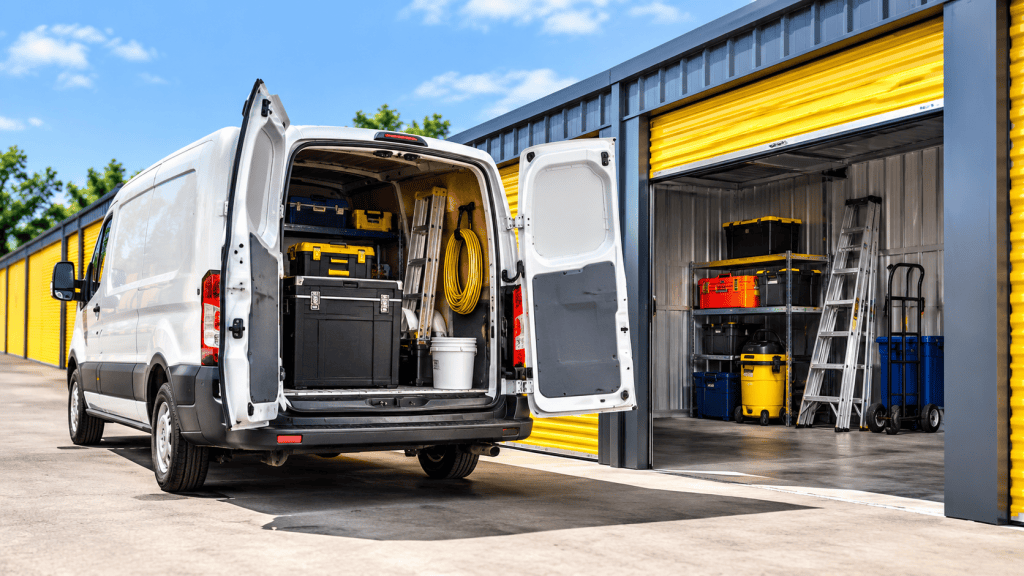
Drive-up storage lets you park your van right outside your unit, open the doors, and load or unload straight from the vehicle. No elevators, corridors, or carts stand between you and your gear. For builders, electricians, contractors, and growing businesses, van access storage units turn a storage stop into a quick, practical part of the working day instead of a time-consuming chore. This guide explains how the setup works, from booking and gate entry to sizing, security, and the checks worth making before you sign up.
How Does Drive-Up Storage Work for Vans and Trade Vehicles?
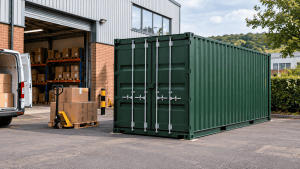
Drive-up storage means each unit sits at ground level inside a fenced, gated yard. You drive through the gate, pull up beside your container, and move items directly between the van and the unit.
1. Booking and moving in:
Most providers have simplified the process so you can be up and running quickly. A typical sequence looks like this:
- Choose your location, unit size, and move-in date.
- Pay the first month online to reserve the unit.
- Receive your confirmation and access details by email.
- Drive to the site, find your unit, and start loading.
Same-day move-in is often possible, subject to availability. No staff member needs to meet you on arrival, because the access details you receive by email let you enter on your own.
2. Getting through the gate at any hour:
Trades rarely keep office hours. Early starts, late finishes, and weekend jobs are normal, which is why 24/7 storage access matters so much. Gate entry usually works in one of two ways:
- Phone-to-open: you call the gate from your registered phone number, and it opens. Only programmed numbers work.
- Keypad code: you enter a personal code at the gate, day or night.
The method varies by site, so check which one applies before your first visit.
3. Loading and unloading at the unit:
This is where ground-level storage really earns its keep. You can back a car or van up to the container doors and transfer items in a few trips. Many containers have internal lighting, so evening loading is simple, and power is often available on request for charging cordless drills, batteries, and other site equipment.
One detail worth confirming: not every container on every site is on the ground floor. Some locations also have stair-access units, so if you need to drive right up to the door, say so when you book.
4. Choosing the right container size:
Drive-up storage containers come in a range of sizes. Common options include:
- 8 ft: compact space for a few tools, cases, or seasonal stock.
- 10 ft (about 80 sq ft): room for a small trade setup or modest inventory.
- 20 ft (about 160 sq ft): roughly a large single garage, and the most popular choice for business customers. It suits tools, materials, and stock for a small business.
- 40 ft (about 320 sq ft): extra capacity for contractors, events teams, and fit-out crews.
Sizes vary by site. If you have outgrown containers altogether, ground-floor warehouse units of 300 sq ft or 500 sq ft offer a next step, with power connected and space for light work.
5. Security that suits valuable tools:
Van theft and break-ins are a constant worry for tradespeople. Leaving expensive equipment in a vehicle overnight is a risk many no longer want to take. Good secure tool storage typically includes:
- A fully fenced and gated yard
- Recorded CCTV across the site
- Lighting after dark
- Entry restricted to registered customers
- Your own padlock on your unit
Keep in mind that recorded CCTV is not the same as someone watching live. It is a deterrent and a record, so a strong lock still matters.
6. Rules and terms:
Most sites ban flammable materials, chemicals, and perishable food.
Flexible storage terms are another reason trades choose drive-up units. Contracts usually run month to month, with no deposit, no setup fee, and one month’s notice before your next bill date. That makes it easy to scale up during a busy season and scale back when work slows down.
Bottom line
Van access storage units remove the hardest part of storage: getting things from the vehicle to the unit. With ground-level containers, round-the-clock gate access, secure yards, and month-to-month terms, they give trades and businesses a practical base for tools, materials, and stock. Before booking, confirm the access method, the unit’s floor level, available sizes, and the site rules for the location you choose.
For secure drive-up storage across London and Hertfordshire, explore WOW Storage business container storage or find your nearest WOW Storage site.
Frequently Asked Questions
What are van access storage units?
They are storage units you can drive a van right up to, so you load and unload directly from the vehicle without elevators or corridors.
Can I access drive-up storage 24 hours a day?
Many sites offer 24/7 access, 365 days a year, using a registered phone number or a keypad code at the gate.
What size storage container fits trade tools and materials?
A 20 ft container (about 160 sq ft) suits most small trade and business needs, while a 40 ft container (about 320 sq ft) suits larger equipment. Sizes vary by site.
Is it safe to store power tools in a storage container?
Yes, when the site is fenced, gated, and covered by recorded CCTV, and you secure the unit with your own lock.
Do I need a long contract for drive-up storage?
No. Many providers offer month-to-month terms with no deposit or setup fee and one month’s notice to cancel.