
You’ve decided you need storage. Good decision!
Now comes the part nobody warns you about; picking the wrong size and living with it for six months. If it is too small, you’re playing Tetris every morning before a job. If it is too big, you’ll end up paying rent on empty floor space.
Now neither is a storage problem here. In fact, both are a planning problem. This guide fixes that. We’ll go through storage unit sizes for business in UK, what fits your needs, and which type of business genuinely needs each one.
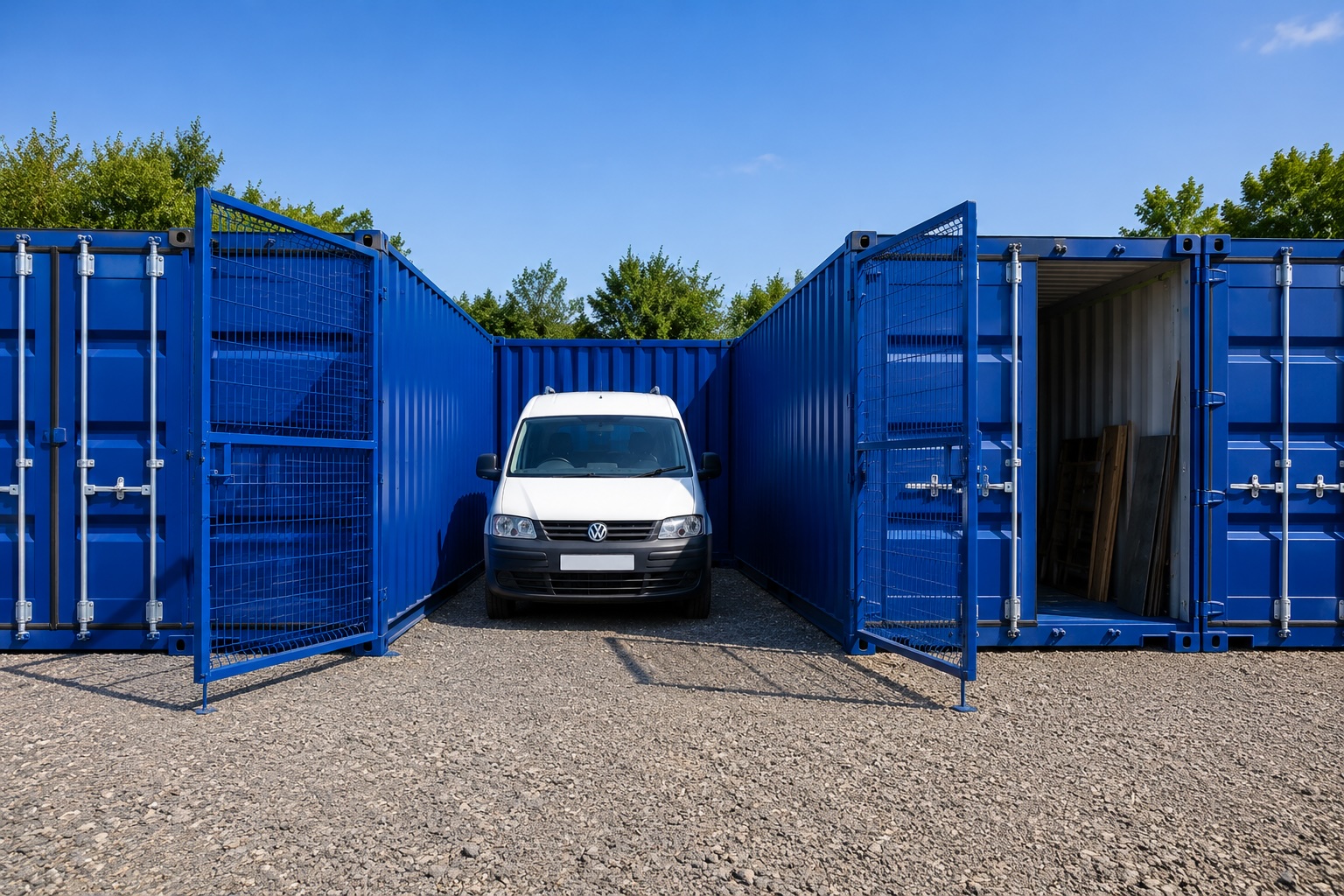
First: Start Thinking About Use Not Storage Unit Sizes
Most storage unit size guides UK lead with a table.
Square footage
A rough item count
Maybe a comparison chart.
That’s useful later. But it skips the question that matters most.
How are you going to use the unit day-to-day? A business that visits twice a year can pack floor-to-ceiling. Every cubic inch is usable.
A tradesperson visiting every morning before a job cannot operate that way. They need to find things quickly. That means organised shelving, a clear aisle, and room to move.
Technically their volume might fit in at 10ft. Functionally they need 20ft.
Volume is one thing. Workflow is another. Workflow almost always wins. So before you look at sizes, answer these three honestly:
How often will you visit? Daily access means you need working space, not just storage space.
What’s your largest single item? Ladders, pipe lengths, display boards; they dictate minimum unit length before anything else goes in.
Are you storing for now or for growth? Upsizing mid-lease costs a working day. Going one size up costs less than you think.
Now Let’s Talk About Storage Unit Sizes for Business UK Edition
It may seem simple: choose a size, move your items in, and get back to work. However, the right unit can make a real difference to how smoothly your operation runs day to day. Here are the container sizes available to meet the needs of storage containers for growing businesses:
10ft Container: The Focused Option
Internal size: ~2.85m long × 2.35m wide × 2.39m high
Floor area: ~75 sq ft
Think of this as a very large, secure cupboard. It’s useful, but for a specific type of user.
A sole trader storing hand tools and consumables. A market trader with seasonal stock. A small online business with one or two product lines and low volume. These users get good value from a 10ft.
For anyone who needs to access different items on different visits, space can become difficult to manage very quickly. With Secure Container Storage in Heathrow, you can organise your belongings more efficiently, but even then, adding one shelving unit, a few bulky items, and several boxes can make it challenging to reach anything stored at the back.
One thing most people don’t know: a 10ft container is a cut-down modified unit, not a standard ISO container. The cost per square metre is often higher than a 20ft, not lower. If you’re deciding on budget, check the price per square foot before assuming smaller is cheaper.
20ft Container:The One Most Businesses Actually Need
Internal size: ~5.9m long × 2.35m wide × 2.39m high
Floor area: ~150–160 sq ft
This is the workhorse.
When businesses search container storage sizes London, this is the standard. It’s available everywhere.
It covers the vast majority of real commercial needs. And it’s the first size where you can properly work inside the unit,not just store in it.
You can run racking down one side, keep a central aisle, and still have depth at the back for larger items. That’s the difference between storage you manage and storage that manages you.
Here’s what fits comfortably in a well-organised 20ft:
- Full trade kit – power tools, hand tools, consumables, plus a van-load of materials
- E-commerce stock for a business processing 50 to 200 orders a week
- Event equipment – tables, chairs, display stands, lighting
- Seasonal retail overflow, clearly separated by season
- Catering equipment – folding tables, serving kit, cold boxes
- Smaller plant equipment between project phases
A 20ft storage unit London is also the first size that takes a standard pallet properly. If your suppliers deliver on pallets, this is your entry point.
Here’s the honest reality: most businesses that think they need a 10ft actually need a 20ft. And most that think they need a 40ft are surprised by how much a properly organised 20ft holds.
40ft Container: When You’re Running a Facility, Not Just a Unit
Internal size: ~12.0m long × 2.35m wide × 2.39m high
Floor area: ~300 sq ft
Twice the length. But it’s a different category entirely, not just a bigger box.
At this size, you stop renting storage and start running a facility. Racking down both sides, full central aisle, space for oversized items, room to receive deliveries and sort them properly. Some businesses run basic pick-and-pack operations from inside a 40ft.
The businesses that genuinely belong here:
High-volume retailers and distributors. Hundreds of units moving weekly. You need a system, not a pile.
Larger contractors and multi-van trades. Centralising materials and equipment across multiple sites. One well-stocked unit beats three chaotic vans.
Events and hospitality businesses. Marquees, staging, PA systems, large furniture. These items are expensive, irregular in shape, and a nightmare to store inefficiently.
Businesses running two operations in parallel. An e-commerce brand that also does trade fairs, for example. The 40ft holds both without constant reshuffling.
Practical note: a 40ft needs more site space for delivery and positioning. Always confirm vehicle access before committing.
Cut Through the Confusion: Which Container Storage Size for Business UK Fits Your Business?
After watching how businesses move in, upsize, and occasionally wish they’d thought this through earlier, the pattern is pretty consistent. The right unit comes down to being honest about how you actually operate.
You can run through the scenarios below and the answer usually becomes clear on its own.
You probably need a 10ft if you’re a sole trader with light kit, storing for archiving, or running very low stock volumes with infrequent access.
You probably need a 20ft container if you’re a tradesperson with a full kit, an e-commerce business with growing inventory, a retailer managing seasonal stock, or any operation that needs Overflow Business Storage Solutions in London for easy access to different items on different visits.
You probably need a 40ft if you’re running high volume, storing large or irregular equipment, managing multiple vans and teams, or you outgrew a 20ft within your first two months.
When genuinely unsure, go one size up
The monthly cost difference between 20ft and 40ft is smaller than people expect. The cost of moving everything from the wrong unit into the right one (in time, lost working days, disruption) is considerably higher.
High Cube Containers: Worth Knowing About
Standard containers give you roughly 2.39m of internal height. A high cube adds around 30cm, bringing it to approximately 2.69m.
For boxes and pallets, standard height is fine.
If you’re installing tall racking, storing signage frames, exhibition stands, or anything that needs to stand upright, the extra headroom matters more than it sounds. It also helps to consider practical questions such as Can You Safely Store Power Tools and Machinery in a Storage Unit? so your storage setup works safely and efficiently. Spending 20 minutes hunched over every morning can become a slow, unnecessary drain.
It is worth asking about and often not much more expensive.
Final Words: Storage Unit Sizes Are Only Half the Decision
Choosing the right storage unit sizes for business UK isn’t really about square footage. It’s about how you work. And your daily routine is the answer.
Because even the right storage unit size is the wrong choice if it’s in an inconvenient location. Choosing Drive-Up Storage Units in Heathrow can make access easier for businesses that need regular visits. Still unsure? Tell us what you’re storing, how often you’ll need access, and the size of your largest item.
That’s the conversation we have at WOW Storage. With our WOW Storage Business Storage Solutions, container storage sizes are tailored to suit the way London businesses actually operate.
Talk to the Wow Storage team about the right unit for your business.
Frequently Asked Questions
Start with access frequency rather than volume. Daily visits mean you need working space, not just stacking space and that almost always means going one size up. The price gap between sizes is smaller than most people expect, and far smaller than the cost of moving everything twice.
Yes, and for most businesses, you should. It converts floor space into vertical space and makes the unit genuinely workable. Measure your racking before you rent and check whether you need a high cube for the headroom.
Not always. Cost per square metre on a 10ft is often higher due to the modification work
involved. Compare price per square foot, not just the monthly headline figure.
Not necessarily. Because 10ft units are modified cut-down containers, the cost per square metre is often higher than a 20ft despite the lower monthly figure. Always compare price per square foot before assuming smaller means cheaper.
Most facilities will let you upsize or downsize, but it comes at a cost that goes beyond the rental difference. You’re looking at a full moving day, disrupted operations, and working hours spent on logistics rather than your actual business. Getting the size right from the start is always the cheaper option, even if the bigger unit costs a little more each month.